
The Common Misconception
Walk into any flight school and mention wanting your private pilot certificate, and someone will ask: "Are you going commercial?" It's shorthand for "Are you serious about this?" But it creates a false choice. Either you're building toward an airline job, or you're just doing this for weekend pleasure flights.
The reality is different. An instrument rating sits in the middle. It's not required for a career, but it changes what you can do with your private pilot certificate. And if you want to fly regularly, not just on perfect weather days, it's a valuable option. This is an honest look at why thousands of leisure pilots get their IR not because they need it for work, but because it makes flying more possible.
The Weather Problem Nobody Wants to Talk About
Most private pilots learn this the hard way: VFR only works when the weather cooperates.
You get a gorgeous morning forecast, plan a flight to Naples or down to the Keys, and by the time you're halfway there, a pop-up thunderstorm rolls in. VFR only means you can't fly into it. You can't navigate through it. Your options are to divert, turn back, or land and wait. This happens more than pilots would like to admit, and can change your plans in the blink of an eye.
Weekend trips get cancelled. Family plans change. You drive instead of fly. The license you worked hard for sits in your pocket, unused, because the weather doesn't match what VFR requires.
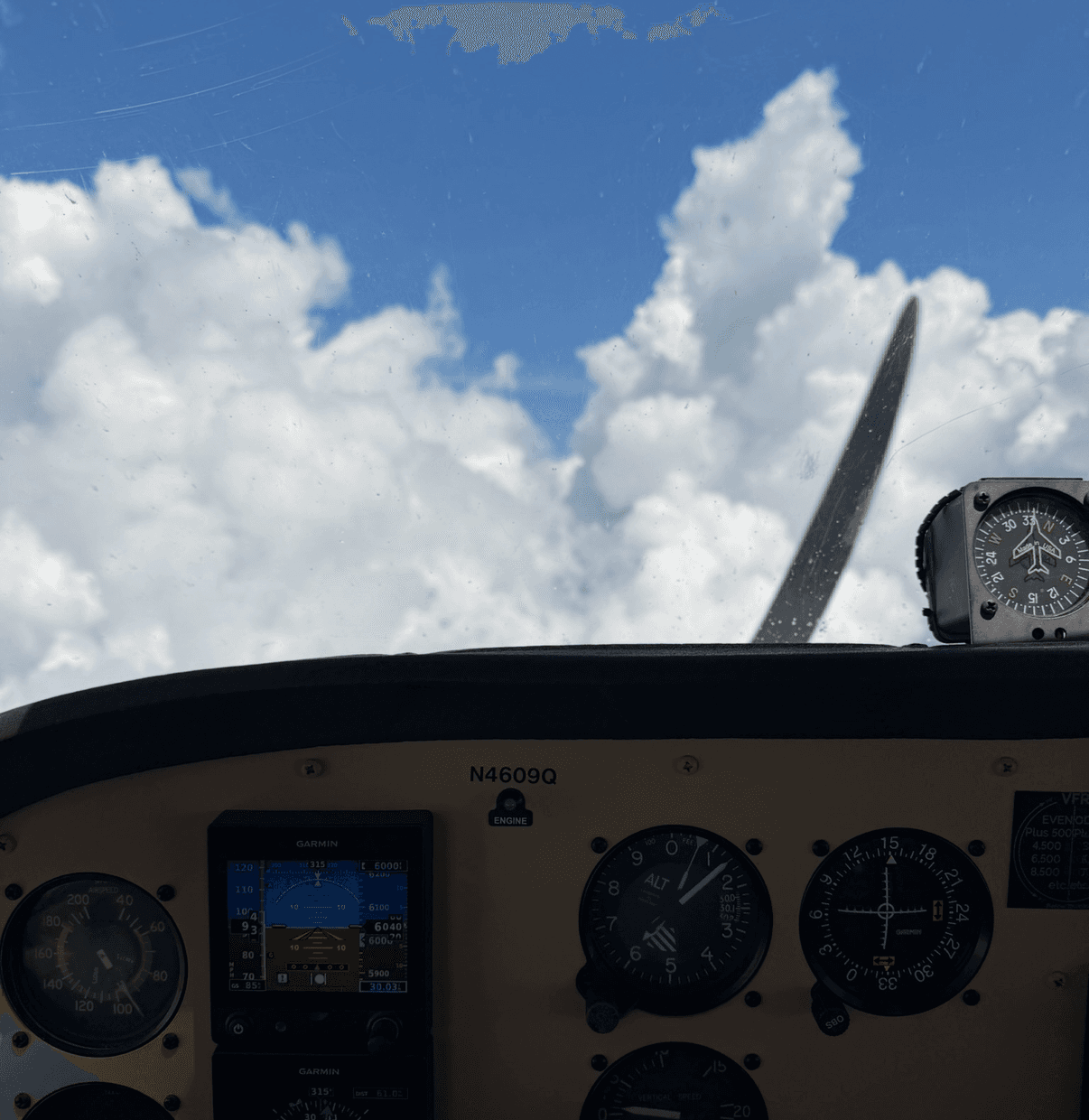
An instrument-rated pilot still can't fly into severe weather. But they can navigate through light to moderate conditions that would stop a VFR-only pilot. They can file an IFR flight plan and legally fly through cloud coverage. They can plan trips knowing weather won't necessarily stop them. That's not being reckless. That's the whole point.
IFR changes that. You can plan a trip knowing that light rain, broken clouds, or overcast conditions won't stop you. You're not flying into thunderstorms or zero visibility. You're still flying through safe conditions that VFR pilots simply can't operate in.
Suddenly, trips to the Bahamas, a weekend in the Keys, visiting family across the state can actually happen. Severe weather might still delay you a few hours or push your departure to the next day, but it rarely stops you altogether.
That's why people who get their IR rating fly trips more consistently. They don't just log more hours. They use their license for what it's supposed to be for: getting somewhere.
Safety Margins Get Wider
This is where the technical part meets common sense.
An instrument-rated pilot flying IFR operates within a system. ATC knows where you are. Terrain avoidance is structured. Navigation is known and precise. Your flight plan has decision points built in.
A VFR pilot in marginal conditions is working it out as they go. They're looking out the window, deciding in real time whether it's still safe to continue.
VFR into IMC, inadvertent instrument meteorological conditions, remains one of the leading causes of general aviation accidents. Most of those pilots didn't plan to fly into clouds. Weather changed, or they misjudged it, or they wanted to get somewhere and pushed just a little further.
An instrument-rated pilot still makes bad decisions sometimes. But the rating eliminates a whole category of risk: the VFR-only pilot making a marginal call and getting it wrong. For leisure pilots, that's a real safety improvement. You're not just flying more. You're flying more safely.
You Actually Become a Better Pilot
This is harder to measure but worth saying: instrument training makes you a better VFR pilot too.
IR training forces you to understand your airplane more deeply. You learn to fly by instruments when you can't see the ground. You learn navigation systems, approach procedures, emergency management. You practice precision in ways that VFR training doesn't push you to do.
Then you go back to VFR flying, and it all carries over. Your flying is more precise. You understand your systems better. You read weather and make aviation decisions differently than before.
Leisure pilots who get their IR often say the same thing: they feel more confident and sharper as pilots, even on clear VFR days. The rating didn't just expand where they could fly. It made them better pilots overall.
The Timeline and Cost Reality
Let's be honest: instrument rating training takes time and money.
A Part 141 structured course, like GoFly's IR program, requires 35 hours of flight time, including simulator time partnered with your ground school. Depending on your pace, you're looking at several months. The total cost for aircraft rental, instruction, and of course start at $10,600.
But here's what matters: that's the cost of turning your private pilot license from something you use twice a year into a tool you actually use.
If you fly four times a year, an IR might not make sense. But if you fly monthly, or if you want to take trips but weather keeps stopping you, the IR pays for itself in trips completed and capability.
For leisure pilots, it's really about whether you want your flying to actually happen reliably.
The Part 141 Advantage for IR Training
Structured Part 141 training really matters for IR more than it does for PPL. You need weather, navigation, approach procedures, emergency management, precision flying, and the ability to make good decisions when you can't see outside.
Part 141 programs like GoFly's are built for this. The training is sequenced so each skill builds on the last. You're not just stacking random hours. You're following a structured path where ground school, simulator, and flying reinforce each other.
And here's the thing: GoFly's FAA Examining Authority means your end-of-course checkride happens in-house, no DPE scheduling delays. DPE fees in Florida are running upward of 1,500 dollars and scheduling is tough. That's a real advantage. You finish training, you check out, you're done. No waiting months for an external examiner to open up a slot.
The Actual Payoff
An instrument-rated leisure pilot isn't flying into thunderstorms or zero visibility. They're not doing anything crazy. They're flying trips that would otherwise get cancelled. They're using their license in conditions that ground VFR-only pilots.
They're visiting family and actually arriving when they said they would. They're taking cross-country trips without checking the weather forecast for three weeks before committing. They're using their airplane as a tool instead of entertainment for perfect weather days.
For leisure pilots, that's the whole point. Not career advancement. Not another certificate to frame. Just the ability to actually fly. If that sounds worth it to you, an instrument rating is worth thinking seriously about. It takes commitment, but it's one of the best investments a leisure pilot can make to actually use their license.
If you're looking at instrument training in Miami and want to see what a structured Part 141 program looks like, we can walk you through it. It's more straightforward than most pilots think.