What to Look for in a Flight School in Miami Before You Enroll
Miami is home to a lot of flight schools. Between Opa-locka Executive Airport (KOPF), Miami Executive Airport (KTMB), and North Perry Airport (KHWO), South Florida students have more options within a short drive than most of the country. That's a good problem to have, but it also means the decision takes more than picking whichever school shows up first in a search.
Most people researching flight training in Miami start by comparing price per hour, and that's a reasonable place to start. But it's really just one piece of a bigger picture. Fleet size, instructor availability, program structure, examining authority, and the airport itself all play a role in how smoothly your training goes and how prepared you'll be for the kind of flying you want to do afterward.
Before committing to a program, it helps to work through a short list of questions alongside the hourly rate.
Fleet Size
A bigger fleet sounds like an obvious advantage, and in some ways it is. More airplanes generally means more scheduling flexibility and less risk of your training stalling out because a single aircraft is down for maintenance.
But fleet size only means something relative to how many students are trying to use it. A school with a large fleet and an even larger student roster can still leave you competing for airplane time. A smaller school with a tightly managed schedule can sometimes get you into the air more reliably than a bigger one. Ask how many active students are sharing the fleet, not just how many airplanes are on the ramp.
Fleet Variety
Beyond raw numbers, it's worth asking what kinds of aircraft are actually available. A school that only offers one airplane type can still teach you well, but a school with a mix of aircraft, such as a straightforward trainer for building fundamentals, a more advanced glass-cockpit or technically advanced airplane, and a multi-engine option, gives you room to grow without transferring schools mid-training.
If you know you'll eventually want an instrument rating, multi-engine time, or exposure to more advanced avionics, ask now whether that's available in-house or whether you'll need to go elsewhere later.
Student-to-Instructor Ratio
This is one of the most underrated questions a prospective student can ask. A school can have plenty of airplanes and still leave you waiting weeks for lesson slots if instructors are stretched too thin across too many students.
A high student-to-instructor ratio often means less continuity. You may see different instructors from lesson to lesson, which can slow your progress since each one has to re-learn where you left off. A lower ratio generally means more consistency, more availability, and an instructor who actually knows your specific weak points and how you learn.
Part 141 vs. Part 61
Flight schools generally operate under one of two FAA certification structures, and the difference matters more than most new students realize.
Part 141 schools follow an FAA-approved, structured curriculum with defined stage checks and closer FAA oversight. This structure can allow for reduced minimum flight hours for certain certificates, and it's often required or preferred for students planning to use financial aid, VA benefits, or a defined airline pathway program.
Part 61 training is more flexible. There's no FAA-approved syllabus requirement in the same way, which allows instructors to adjust the pace and order of training more freely around a student's schedule and learning style. It doesn't offer the same reduced-hour minimums, but it can be a good fit for students who want a less rigid, more customized experience.
Neither structure guarantees better instruction on its own. What matters is whether the structure fits your goals and your learning style.
Examining Authority
One thing many prospective students never think to ask about is whether a school holds FAA examining authority. Part 141 schools can apply for and be granted this authority, which allows their own senior certificated instructors to conduct certain stage checks and practical tests in-house, rather than relying entirely on outside Designated Pilot Examiners (DPEs).
This can make a noticeable difference in how smoothly training moves along. Outside DPEs in South Florida, especially with the volume of students training across Miami-area airports, can be booked out for weeks, and checkride fees charged by independent examiners can run several hundred dollars or more depending on the certificate. A school with examining authority can often schedule checkrides internally, which tends to mean shorter waits and lower testing costs.
Very few flight schools in South Florida hold examining authority at all. GoFly Academy is one of them, and holds examining authority for both the Private Pilot and Instrument Rating courses, meaning students can complete those checkrides with GoFly's own designated examiner rather than waiting on outside DPE availability.
When you're comparing schools, it's worth asking directly whether examining authority is held, and for which certificates. If it isn't, ask how far in advance checkrides typically need to be scheduled and what DPE fees generally run in the area.
Pilot Factories vs. Pilot-Centered Schools
Among larger schools especially, there's a real difference between programs built to move high volumes of students through as efficiently as possible, and programs built around the individual student's progress.
High-volume programs, sometimes called pilot factories, exist because there's real demand for them. Students on a fast track to the airlines often want volume, structure, and a predictable timeline more than a personal relationship with one instructor. These programs often rely on newer instructors who are themselves building hours before moving on, so you may work with several different instructors along the way.
A more pilot-centered school usually trades some of that scale for continuity: fewer students moving through at once, and a program built around getting a specific student to proficiency rather than moving as many people through as possible. Neither model is wrong. What matters is which tradeoff fits what you're looking for.
The Airport Itself
It's easy to overlook, but the airport a school operates from shapes your training experience just as much as the aircraft or the instructors do, and this is especially true in Miami, where the training airports are genuinely different from one another.
Miami Executive (KTMB) and North Perry (KHWO) are both busy, well-established training airports, each home to more than five flight schools. That concentration has a real upside: plenty of activity, a strong sense of aviation community, and instructors all over the field. It also comes with a cost. With that many schools sending training aircraft into the same pattern, sequencing gets tight, and it's common to spend real time holding short or extending a leg for spacing, time that's usually still on the clock.
Opa-locka Executive Airport (KOPF) is a different kind of field. It's a controlled Class D business aviation airport, with a traffic mix that includes corporate and jet operations alongside training flights, rather than five or more schools running the same pattern maneuvers at once. That environment gives students earlier exposure to the kind of radio communication, ATC coordination, and operating tempo they'll actually encounter later in a flying career, while generally meaning less time spent waiting on the ground between lessons.
None of this makes KTMB or KHWO the wrong choice, and plenty of excellent pilots have trained at both. It's simply a different environment with different tradeoffs, and worth asking about directly: how many schools operate from this airport, how saturated does the pattern get at peak hours, and what kind of traffic will I actually be training around?
Putting It All Together
None of these questions has one universally correct answer. The right flight school depends on your goals, your schedule, your budget, and how you learn best. But asking about fleet size, fleet variety, student-to-instructor ratio, Part 141 vs. Part 61, the school's overall training philosophy, and the airport environment will tell you far more than a price sheet ever will.
A short checklist to bring with you when you tour a school:
How many active students share the current fleet, and how does that affect scheduling?
What aircraft are available now, and what will be available as I advance?
What's the realistic student-to-instructor ratio, and will I have a consistent instructor?
Is the program Part 141 or Part 61, and does that fit my goals and schedule?
Does the school hold FAA examining authority, or will checkrides go through an outside DPE?
Is this a high-volume program or one built around individual progress, and which do I want?
What airport does the school operate from, and what kind of traffic will I be training around?
How many other schools operate from that same airport, and how saturated does the pattern get?
Flight Training at GoFly Academy
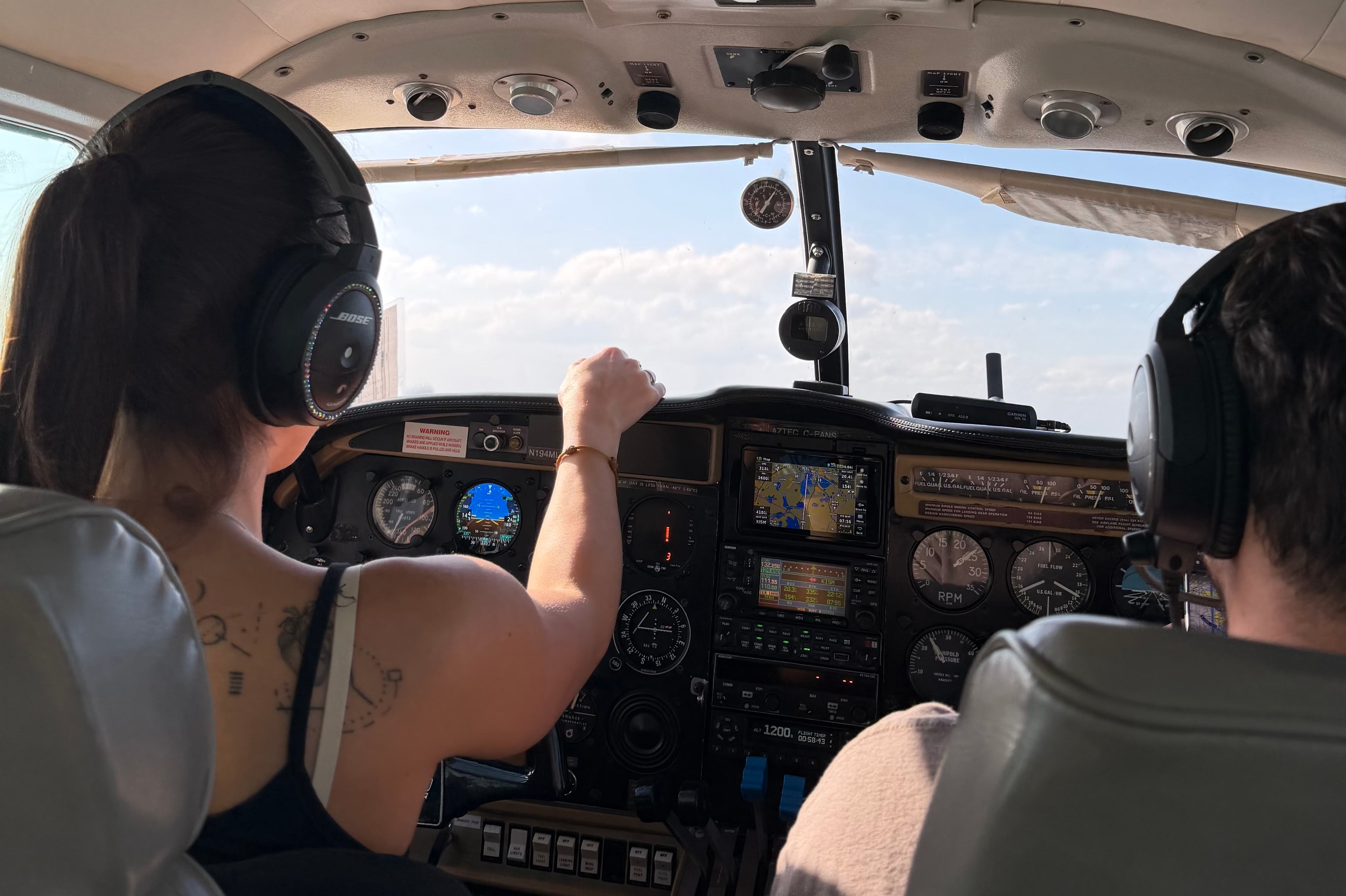
At GoFly Academy, we've built our program around these exact questions. We operate a varied fleet, from the Cessna 172 to the Cirrus SR20 and Piper Aztec, out of Opa-locka Executive Airport (KOPF), a professional Class D business aviation airport with regular corporate and jet traffic alongside training flights. We also hold FAA examining authority for both the Private Pilot and Instrument Rating courses, one of the few schools in South Florida that can say that, which means shorter waits and fewer surprises when it's time for a checkride.
If you're comparing flight schools in Miami and want to see how these factors play out in person, the best way to find out is to experience it yourself. Schedule a discovery flight with GoFly Academy today.