
If you're researching flight schools in South Florida, you've probably come across some version of the same warning: Miami's airspace is complicated. That's true, but it's also one of the best reasons to train here. Flying in and around Class B airspace, talking to some of the busiest approach controllers in the country, and sharing the sky with everything from airliners to seaplanes forces you to become a sharper, more situationally aware pilot much earlier than you would at a quieter airport.
Here's what that actually looks like day to day.
The Miami Class B Shelf
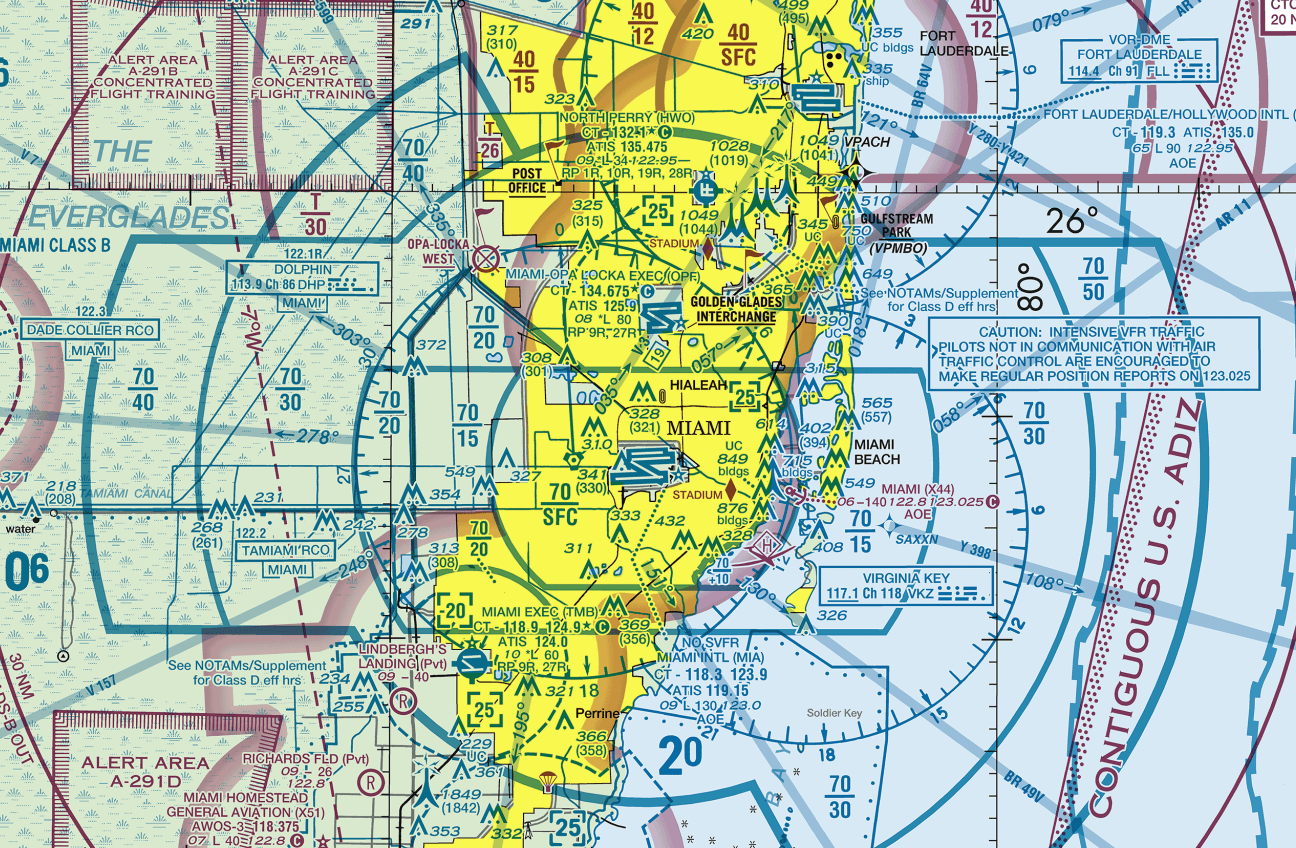
Miami International Airport (KMIA) sits at the center of Class B airspace that extends outward in a series of "shelves," meaning the floor of the controlled airspace steps down the farther you get from the airport. Close to KMIA, the airspace can start at the surface. Farther out, it might not start until 3,000 or 4,000 feet.
For a student pilot flying out of Opa-locka Executive (KOPF), North Perry (KHWO), or Miami Executive (KTMB), this means altitude awareness isn't optional. You need to know exactly where the shelves are relative to your position, because drifting a few hundred feet or a mile in the wrong direction can put you inside Class B without clearance. Instructors here spend real time on this early, not because it's exciting, but because it's a skill you'll use on nearly every flight.
Working With Miami Approach
Once you start doing cross-country work, you'll likely talk to Miami Approach at some point, whether you're requesting flight following, transitioning around the Class B, or just staying in the loop as traffic gets busy. Miami Approach handles a huge volume of traffic, from airline arrivals into MIA and Fort Lauderdale to general aviation aircraft weaving between training areas.
This is genuinely useful experience. A lot of private pilots go through their entire training without ever talking to a busy approach controller, and then find it intimidating the first time they need to. Training in Miami removes that learning curve early. You get comfortable with quick, efficient radio calls because the frequency doesn't leave much room for hesitation.
Sharing the Sky With Everything
South Florida's airspace isn't just busy, it's varied. On a single flight you might see:
Airliners inbound to MIA or FLL
Helicopters operating around the coastline and hospitals
Seaplanes and light sport aircraft near the waterways
Military traffic transiting through the area
A steady stream of other training aircraft from the region's flight schools
That mix teaches you to scan differently than you would in a quieter part of the country. You start looking for things other than just airplanes shaped like airplanes, and you get used to controllers issuing traffic calls in rapid succession.
What This Means for Training Pace
None of this means training in Miami is harder in a way that slows you down. If anything, it tends to build good habits faster. Students here typically develop stronger radio discipline, better airspace awareness, and more confidence handling traffic because they're doing it from day one instead of easing into it later in their training.
It does mean your instructor will spend more time up front on airspace briefings than you might get somewhere with simpler airspace. That's a good trade. Understanding the "why" behind Class B shelves, transition routes, and approach procedures pays off well beyond your private pilot checkride. It's the same kind of airspace awareness you'll rely on for the rest of your flying career, whether that's flying for fun or working toward the airlines.
Choosing an Airport That Fits Your Training
Not every Miami-area airport sits inside the same piece of the puzzle. Opa-locka, North Perry, and Tamiami each have their own relationship with the Class B shelf, their own typical traffic patterns, and their own personality in terms of tower communication style. If you're comparing flight schools, it's worth asking which airport you'll actually be flying from and what that means for your day-to-day training environment, not just the school's general reputation.
At GoFly Academy, we fly out of Opa-locka Executive Airport (KOPF). Compared to some of the other training airports in the area, KOPF has fewer flight schools operating out of it, which means less congestion in the pattern and fewer Cessnas stacked up in the delta waiting for a turn. KOPF also sees a good amount of business and corporate aviation traffic, so students get exposed to a more professional operating environment earlier than they would somewhere dominated almost entirely by training traffic. It's busy enough to build real skills, without the added noise of competing for pattern space all day.
If you're weighing flight schools in the Miami area and want to talk through what training here is actually like day to day, we're happy to answer questions.