If you've started researching flight schools, you've probably come across the terms "Part 61" and "Part 141" without much explanation of what the difference actually feels like day to day. One of the biggest practical differences is the stage check — a structured checkpoint built into Part 141 training that doesn't exist in the same way under Part 61. If you're comparing training programs, understanding how stage checks work will tell you a lot about how a school actually operates.
What Is a Stage Check?
A stage check is a formal evaluation that takes place at the end of a defined block, or "stage," of training. Part 141 syllabi are broken into stages, each covering a specific set of maneuvers, procedures, and knowledge areas. Before a student can move into the next stage, they have to demonstrate that they've actually absorbed what the current stage was designed to teach — not just logged the hours.
Each stage check has two parts:
● An oral ground portion, where the student is questioned on the knowledge areas covered during that stage — regulations, procedures, systems, weather, airspace, whatever applies.
● A flight portion, where the student demonstrates the maneuvers and procedures from that stage to the level of proficiency the syllabus expects.
Stage checks are also conducted by someone other than the student's primary flight instructor — typically the chief instructor, assistant chief instructor, or a designated check instructor. That separation matters. It means a second, more experienced set of eyes is confirming the student is actually ready, rather than relying solely on the judgment of the instructor who's been in the airplane with them every lesson.
GoFly Academy runs its Private Pilot and Instrument Rating courses on the Jeppesen syllabus, which divides each course into three stages. Here's what each one focuses on.
Private Pilot Course: Stage by Stage
Stage I — Building the Foundation for Solo Flight
Stage I is where a student develops the basic skills and habits required to fly safely on their own. This includes the fundamental maneuvers, airport operations, normal and crosswind takeoffs and landings, emergency procedures, and ground reference maneuvers. Before a student can solo, they also have to complete a presolo knowledge exam and briefing, which confirms they understand the regulatory and safety requirements for flying without an instructor on board. The Stage I check — oral and flight — verifies that a student has the foundation needed to solo safely, which happens later on in Stage 2.
Stage II — Cross-Country Skills and Navigation
Stage II introduces short- and soft-field takeoffs and landings, solo flying, navigation using VOR, GPS, and ADF equipment, and night flying. These skills feed directly into the cross-country portion of this stage, where the student gains the knowledge and experience needed to plan and fly cross-country routes and their solos. The Stage II check evaluates proficiency in the advanced maneuvers introduced during this stage along with the student's cross-country planning and execution.
Stage III — Refinement and End-of-Course Readiness
Stage III is focused on building the experience and confidence needed for the private pilot practical test. Students review every maneuver in the syllabus and work toward the level of proficiency expected on the checkride. The Stage III check, conducted by the chief instructor, assistant chief instructor, or a check instructor, is the formal confirmation that a student is ready to move on to the End-of-Course evaluation.
Instrument Rating Course: Stage by Stage
Stage I — Attitude Instrument Flying and Navigation Basics
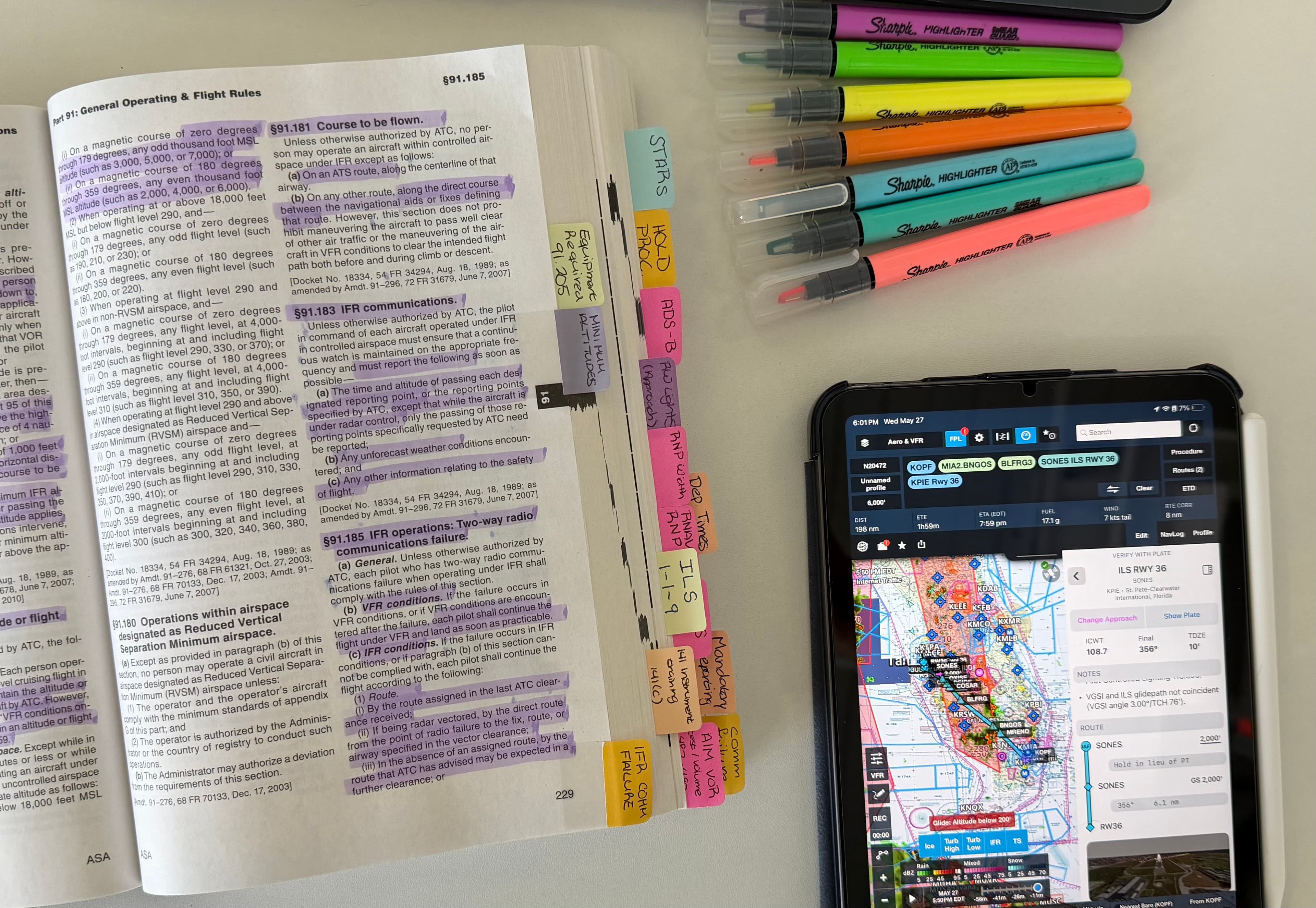
Stage I builds the foundation of instrument flying: controlling the airplane by reference to instruments alone, along with the basics of instrument navigation. By the end of this stage, a student has the groundwork needed to move into holding patterns and instrument approach procedures.
Stage II — Holding Patterns and Approaches
Stage II is where holding patterns and instrument approaches come together. This stage builds the procedural skill required to fly approaches accurately and consistently, which sets up the IFR cross-country work that follows in Stage III.
Stage III — IFR Cross-Country and Final Preparation
Stage III applies everything learned so far to real IFR cross-country flying, typically through three cross-country flights, along with a review of every maneuver in the course. This is also where the ground and flight training portions of the Instrument Rating course are formally completed. By the end of Stage III, a student should be at the proficiency level expected of an instrument-rated pilot and ready for both the FAA Instrument Rating Airman Knowledge Test and the practical test.
The End-of-Course Check — and How Examining Authority Changes It
After a student successfully completes Stage III, there's one more evaluation before they're finished: the End-of-Course check. This is the final, comprehensive assessment of a student's knowledge and flying ability across the entire course, and it's the checkpoint that determines whether a student is ready to be recommended for their certificate or rating.
At most flight schools, this final evaluation is separate from the actual checkride, which has to be scheduled with an FAA Designated Pilot Examiner (DPE). In much of Florida, DPE availability has become a real bottleneck — students can pass every stage check and still spend weeks or months waiting for an examiner slot, all while continuing to fly (and pay) just to stay proficient.
GoFly Academy holds FAA Examining Authority for its Part 141 Private Pilot and Instrument Rating courses, which is uncommon among flight schools in the state. That authority means our chief instructor or assistant chief instructor can conduct the End-of-Course check in-house and issue the graduation certificate directly, for a $300 processing fee. There's no DPE to schedule, no separate checkride fee on top of it, and no waiting on someone else's calendar to finish what a student has already earned.
Why This Structure Matters
Stage checks can look like extra hoops to jump through, but their real function is quality control. Because they're conducted by someone other than the primary instructor, they catch gaps in knowledge or skill before they become habits, and they force an honest checkpoint at regular intervals instead of a single high-stakes evaluation at the very end. By the time a GoFly student reaches their End-of-Course check, they've already been evaluated three separate times by an instructor other than their own — which is a big part of why our students tend to walk into that final check prepared rather than nervous.
It's also a useful thing to ask about when you're comparing flight schools. Every Part 141 program has stage checks in some form, but not every school treats them the same way, and not every school can finish the process in-house. Understanding how a school structures its stages — and who's actually signing off on your progress — is one more way to see how a training program really operates before you commit to it.
If you're weighing flight schools in Miami and want to know more about how our Jeppesen-based Private Pilot or Instrument Rating courses are structured, we're happy to walk through it with you.