

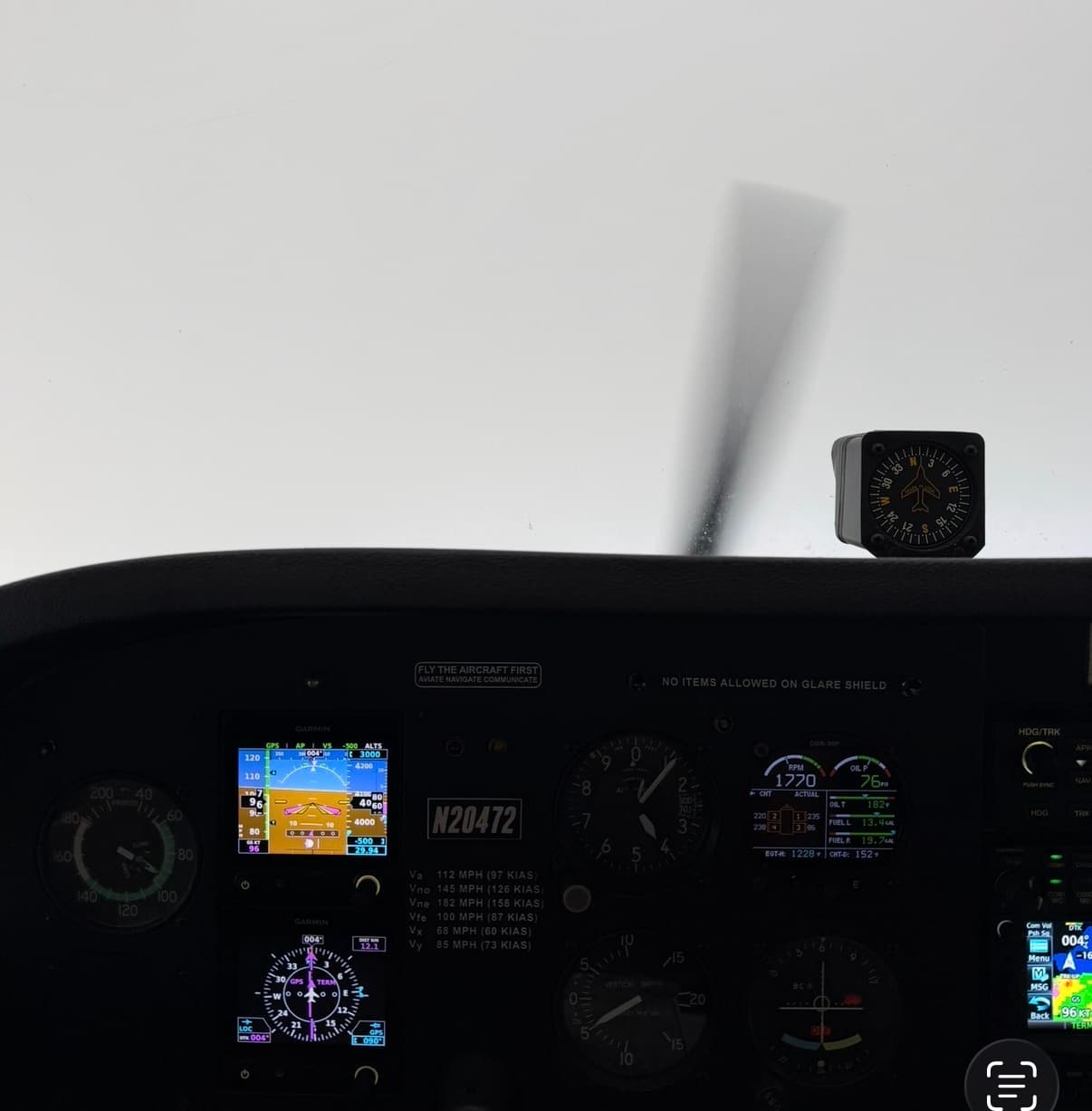
VFR and IFR: What the Letters Actually Mean
VFR stands for Visual Flight Rules. IFR stands for Instrument Flight Rules. Those names sound simple, but they describe two very different ways of navigating and operating an airplane.
VFR means you're flying primarily by looking outside. You maintain separation from clouds, you navigate using visual landmarks (along with GPS and instruments as backup), and you're required to have enough visibility to see and avoid other traffic on your own. This is how every student pilot starts out, and it's how Private Pilots are required to fly unless they add an instrument rating.
IFR means you're flying primarily by reference to instruments, under a system where air traffic control is actively separating you from other aircraft. You can legally fly through clouds, in low visibility, and in conditions where you can't see the ground or the horizon at all.
The rules that govern each type of flying are tied to something called VMC and IMC.
VMC vs. IMC: The Weather Side of the Equation
VMC stands for Visual Meteorological Conditions. This is weather good enough to fly VFR safely: enough visibility, enough distance from clouds, enough of a horizon to keep the airplane oriented using your eyes.
IMC stands for Instrument Meteorological Conditions. This is weather that doesn't meet those VFR minimums. Clouds, fog, haze thick enough to erase the horizon. Flying in IMC without an instrument rating (and without filing an IFR flight plan) isn't just risky. It's illegal, and for good reason. Without a visible horizon, the human inner ear is notoriously bad at telling up from down, which is part of why spatial disorientation is one of the leading causes of fatal accidents involving VFR pilots who accidentally fly into clouds.
This is really the core difference between the two certificates. A Private Pilot flying VFR needs VMC to fly safely and legally. An Instrument-rated pilot can operate in IMC as long as they file an IFR flight plan and stay current.
How This Plays Out in Training
If you're working toward your Private Pilot certificate, virtually all of your training happens in VMC. You're learning to control the airplane, navigate, and make decisions using outside visual references. Good weather isn't optional here. It's the entire foundation of how VFR flying works.
Instrument training is different. Since it wouldn't be practical (or safe) to put a student in actual clouds every time they need practice, instrument students train using a device called a "foggle," or a similar view-limiting hood. It blocks the pilot's view of the horizon and outside world while still allowing them to see the instrument panel clearly. This creates simulated IMC in otherwise clear skies, letting a student practice flying entirely by instrument reference without the added risk of doing it in actual clouds for the first time.
By the time an instrument student is ready for their checkride, they've flown approaches, holds, and full instrument procedures under the hood, building the skill and muscle memory to do the same thing in genuine IMC later on.
Currency: Why an Instrument Rating Isn't a One-Time Achievement
Here's something a lot of new pilots don't realize until they're deeper into training: earning an instrument rating doesn't mean you can fly in IMC indefinitely without upkeep.
The FAA requires instrument-rated pilots to stay current by logging a minimum number of approaches, holds, and intercepting/tracking tasks within a rolling six-month window in order to legally fly in IMC (or to act as pilot in command under IFR in IMC). Fall outside that currency, and you can still fly IFR in VMC, but you'd need to complete an instrument proficiency check before flying into actual instrument conditions again.
This is one of the more practical realities of holding the rating. It rewards pilots who fly IFR regularly and keeps rusty skills from becoming a safety issue in weather where there's no room for hesitation.
Why Even VFR-Only Pilots Should Consider an Instrument Rating
Here's the part that surprises a lot of prospective students. Even pilots who have zero interest in flying through clouds, who only ever plan to fly on clear days for fun or personal travel, benefit enormously from having an instrument rating.
Weather doesn't always cooperate with plans. A pilot flying VFR who unexpectedly encounters deteriorating visibility has very few good options: turn around, land immediately, or in the worst case, continue into conditions they aren't equipped to handle. That last option is where a disproportionate number of serious accidents happen.
A pilot with an instrument rating has another option. If the weather starts closing in, they have the training and legal ability to transition to instrument flying, request an IFR clearance, and let air traffic control help get them safely to their destination or to better conditions. It doesn't mean they're planning to fly in hard IMC every weekend. It means they have a real safety margin built into their skill set instead of relying entirely on the weather staying perfect.
Beyond the safety argument, instrument training also makes pilots noticeably more precise. Flying an approach to minimums, holding an exact altitude and heading, and managing a cockpit under instrument workload sharpens skills that carry over directly into VFR flying too.
What It Actually Means to "File IFR"
For someone new to aviation, filing an IFR flight plan can sound like a complicated formality. In practice, it means something fairly straightforward: you're telling air traffic control your route, altitude, and aircraft information ahead of time, and once airborne, you're operating under their active separation service.
That has a few real, practical benefits:
You have another set of eyes on you. ATC is actively tracking your position on radar and separating you from other IFR traffic. In VFR flying, "see and avoid" puts a lot of the responsibility for traffic separation on the pilot alone. Under IFR, that job is shared with a controller watching a screen.
You get structured guidance through the system. IFR flying uses a defined system of airways, arrival and departure procedures, and instrument approaches, so even when visibility is poor, there's a known, tested path from departure to destination.
You receive real-time weather and traffic information. Controllers routinely pass along updates on weather deviations, traffic advisories, and route changes, giving an IFR pilot more situational awareness than they'd have relying purely on their own observation.
You have a plan on file if something goes wrong. If a pilot fails to check in or something seems off, ATC already has their intended route and altitude, which shortens response time in an emergency.
None of this means IFR flying is without its own workload and challenges. It requires more precision, more communication, and more attention to procedure. But it adds a layer of structure and support that VFR flying, by its very nature, doesn't have.
Choosing Your Path
For a brand-new student, VFR training is exactly where flying should start. It builds the fundamental stick-and-rudder skills and decision-making that every pilot needs, instrument-rated or not. But as training progresses, the instrument rating is worth serious consideration, not just for pilots planning a career in aviation, but for anyone who wants a genuine safety net built into their flying.
If you're weighing your next step after earning your Private Pilot certificate, or you're just starting to research flight training in Miami and want to understand how VFR and IFR training differ, we're happy to walk through what each path looks like and help you figure out what makes sense for your goals.