Why the Multi-Engine Add-On Is the Most Common Route
Once a pilot has their Commercial certificate, they're technically qualified to be paid to fly, but most flying jobs that actually pay well involve multi-engine aircraft. Charter operations, cargo runs, corporate flying, and the eventual move to the airlines all typically involve aircraft with more than one engine.
Rather than building an entirely new certificate from scratch, the Multi-Engine rating is added onto a pilot's existing Commercial certificate. It's a rating, not a separate certificate, which is part of why it's structured so differently from earlier stages of training. There's no minimum flight hour requirement set by the FAA for this add-on. Instead, training is based entirely on what it takes for a given pilot to fly the airplane competently and safely to the checkride standard.
Because it builds directly on skills a Commercial pilot already has, rather than teaching flying from the ground up, it tends to be one of the more efficient ratings to add, and it opens the door to a much wider range of flying opportunities.
How Training Is Structured: AATD First, Then the Airplane
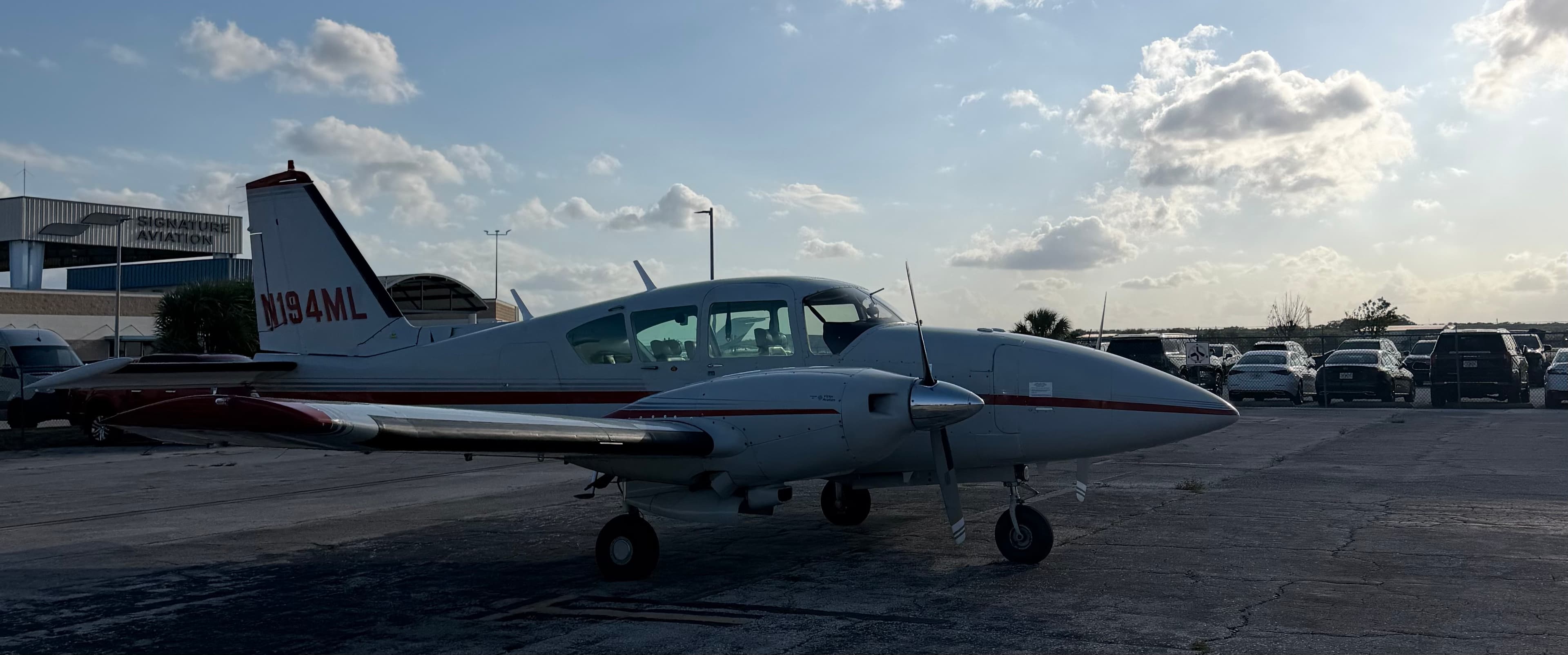
GoFly's Multi-Engine training starts in our Redbird full-motion Advanced Aviation Training Device (AATD), configured with the controls and panel layout matched to the Aztec. Students typically spend around 9 hours in the AATD before moving into the airplane itself.
This matters more in multi-engine training than almost anywhere else in a pilot's training, because a lot of what makes flying a twin different from a single comes down to procedures and decision-making under pressure, especially anything involving an engine failure. The AATD lets a student work through those scenarios repeatedly, in a controlled environment, without the real-world risk or cost of practicing engine-out procedures in the actual airplane every time.
From there, students typically move into around 8 hours of flight time in the Aztec itself, applying what they've built in the simulator to the real airplane.
Every student is a little different. Some move through the maneuvers and procedures faster than others, and the course flexes to match. Because there's no rigid hour minimum, training time is based on genuine proficiency rather than checking a box.
Timing: Training Built Around Your Checkride Date
One thing that sets this course apart from earlier stages of training is timing. Multi-engine training typically begins 1 to 2 weeks before a student's confirmed checkride date.
This is intentional. Multi-engine skills, especially engine-out procedures, are perishable if there's too much time between training and the checkride. Starting close to the exam date keeps the material fresh and avoids the kind of skill decay that can happen when there's a long gap between finishing training and actually testing on it.
What the Commercial Multi-Engine Add-On Covers
The Commercial Pilot Multi-Engine add-on checkride is built around the ACS (Airman Certification Standards) for multi-engine airplanes, and it focuses heavily on the skills that are unique to flying a twin rather than repeating maneuvers already tested during initial Commercial training.
Some of the major areas covered include:
Engine-out procedures — recognizing and responding to an engine failure during takeoff, in cruise flight, and during approach and landing. This is the core of what makes multi-engine training different from anything a pilot has done before.
VMC demonstration — understanding minimum controllable airspeed with one engine inoperative, and why flying a twin below that speed with an engine out can become dangerous quickly.
Single-engine approach and landing — bringing the airplane in safely to land with only one engine producing power, including the additional workload of managing asymmetric thrust.
Performance maneuvers and airwork — steep turns, slow flight, and stalls, performed in a heavier, faster, more complex airplane than most students have flown up to this point.
Systems knowledge — understanding the additional systems a twin brings that a single-engine airplane doesn't have, including how the two engines, propellers, and fuel systems interact.
Normal and abnormal procedures — takeoffs, landings, and go-arounds, along with the emergency procedures specific to losing an engine at various phases of flight.
The checkride tests all of this, but the emphasis throughout training is less about learning new stick-and-rudder basics and more about decision-making, systems management, and handling the airplane confidently when something isn't working exactly as expected.
Why the Transition to the Aztec Is Easier Than It Sounds
Stepping up to a twin-engine airplane can sound intimidating, but the avionics side of the transition is more familiar than most students expect. The Aztec is equipped with the Garmin 430W, the same unit many students trained on during their initial Private and Instrument training in our Cessna fleet.
That familiarity matters. Instead of learning an entirely new avionics suite on top of learning to manage two engines, students can lean on navigation and GPS skills they've already built, and put their full attention toward the parts of the airplane that are actually new: the second engine, the additional systems, and the procedures that come with them.
A Natural Next Step, Not a Steep Departure
The Multi-Engine add-on asks more of a pilot in some specific ways, particularly around engine-out procedures and systems management, but it builds directly on skills already in place rather than starting over. Between the AATD preparation, the familiar avionics, and training scheduled close to the checkride date, most students find the transition more manageable than they initially expect.
If you're finishing up your Commercial certificate and thinking about adding a Multi-Engine rating, we're happy to walk through what the timeline and training would look like for you.