
The FAA knowledge test, commonly called the written exam, tends to sneak up on student pilots. It is required for your private pilot certificate, and how you prepare affects both your confidence and your timeline. Here is how the exam works, a study plan that fits around flying lessons, and where students most often lose points.
How the Exam Works
The private pilot knowledge test is a computer-based, multiple-choice exam taken at an approved testing center. You need a 70 percent to pass, and you need an endorsement from your instructor confirming your ground training is complete. Topics include regulations, airspace, weather, navigation, aircraft systems, performance, weight and balance, and aeronautical decision making.
Your score is valid for 24 calendar months, but most students do better testing earlier, while the material is fresh and they are applying it in the airplane.
Step One: Take Notes in Your Jeppesen Course
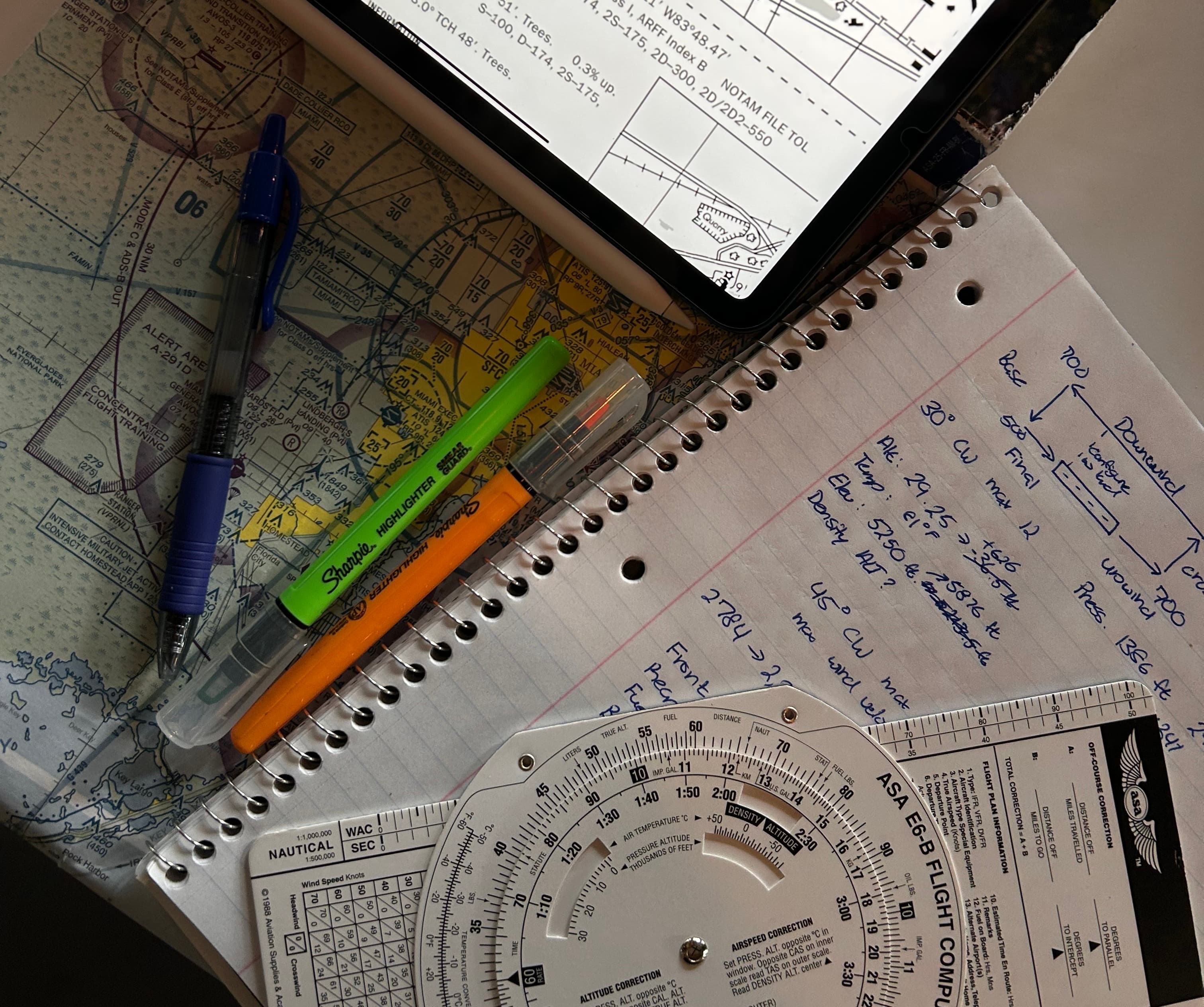
Work through your online course steadily alongside your flying lessons, not all at once at the end. The habit that matters most is taking notes. Watching lessons feels productive, but writing things down forces you to process them.
Write in your own words.
Keep a running list of numbers and memory items, such as VFR weather minimums.
Mark what you do not understand and bring it to your next ground session.
By test time, your notes should be a condensed version of the whole course, so you are reviewing instead of re-reading.
Step Two: Arrive Prepared to Your In-Person Ground Sessions
Your instructor is your best study tool. In-person ground sessions connect abstract textbook topics to what you do in the cockpit. Aerodynamics makes sense once you have flown slow flight and stalls, and weather becomes practical once you are planning cross-countries.
The most important rule is to review the recommended videos in your Jeppesen online course before you come in. Ground time is limited, and it is best spent on questions, problem areas, and applying concepts, not on a first exposure to the material. A student who has already watched the videos can use the session to dig into the details, while a student who has not ends up using the hour just to catch up.
To get the most out of each session:
Bring questions from your videos and notes, not a blank notebook.
Ask why an answer is correct, so a reworded question does not throw you off.
Say which topics feel shaky. An extra session on weather or airspace costs far less than a retake.
Step Three: Practice With Gleim
Knowing the material and answering exam-style questions are different skills. Gleim gives you high-volume practice with explanations, so you get used to how the FAA words its questions.
Start practicing on topics as you finish them.
Read every explanation, including for questions you got right.
Track your weak areas and take them back to your instructor.
Take full practice tests near the end to check your readiness.
At GoFly Academy, your instructor requires at least three Gleim practice tests scored at 90 percent or higher before issuing your endorsement. The standard is deliberately above the 70 percent passing mark. It gives you a cushion for test-day nerves and unfamiliar wording, and it means you are walking in with real command of the material.
Common Weak Areas
Weather. METARs, TAFs, prog charts, fronts, and stability trip up the most students. South Florida’s thunderstorms and sea breeze give you plenty of real examples to learn from.
Airspace. Equipment, communication, visibility, and cloud clearance requirements vary by class. Practice with a sectional chart in front of you.
Weight and balance and performance. Chart-based calculations punish small mistakes. Repeat the process until it is routine, and watch your units.
Navigation. Chart symbols, wind correction, and time, speed, and distance problems all show up, and the manual skills take practice.
Regulations. Currency, required documents, and medical durations are mostly memorization, so notes and repetition help.
Why It Matters Beyond the Test
The knowledge you build for the written exam is what examiners expect you to apply in the oral portion of your checkride. Our FAA examining authority for the private pilot and instrument rating courses means students take their end-of-course exam in-house without waiting on outside examiner availability. Good study habits early keep that momentum going.
If you are considering flight training in Miami and want to know how ground school and flying fit together, we would be happy to answer your questions or set up a discovery flight.