

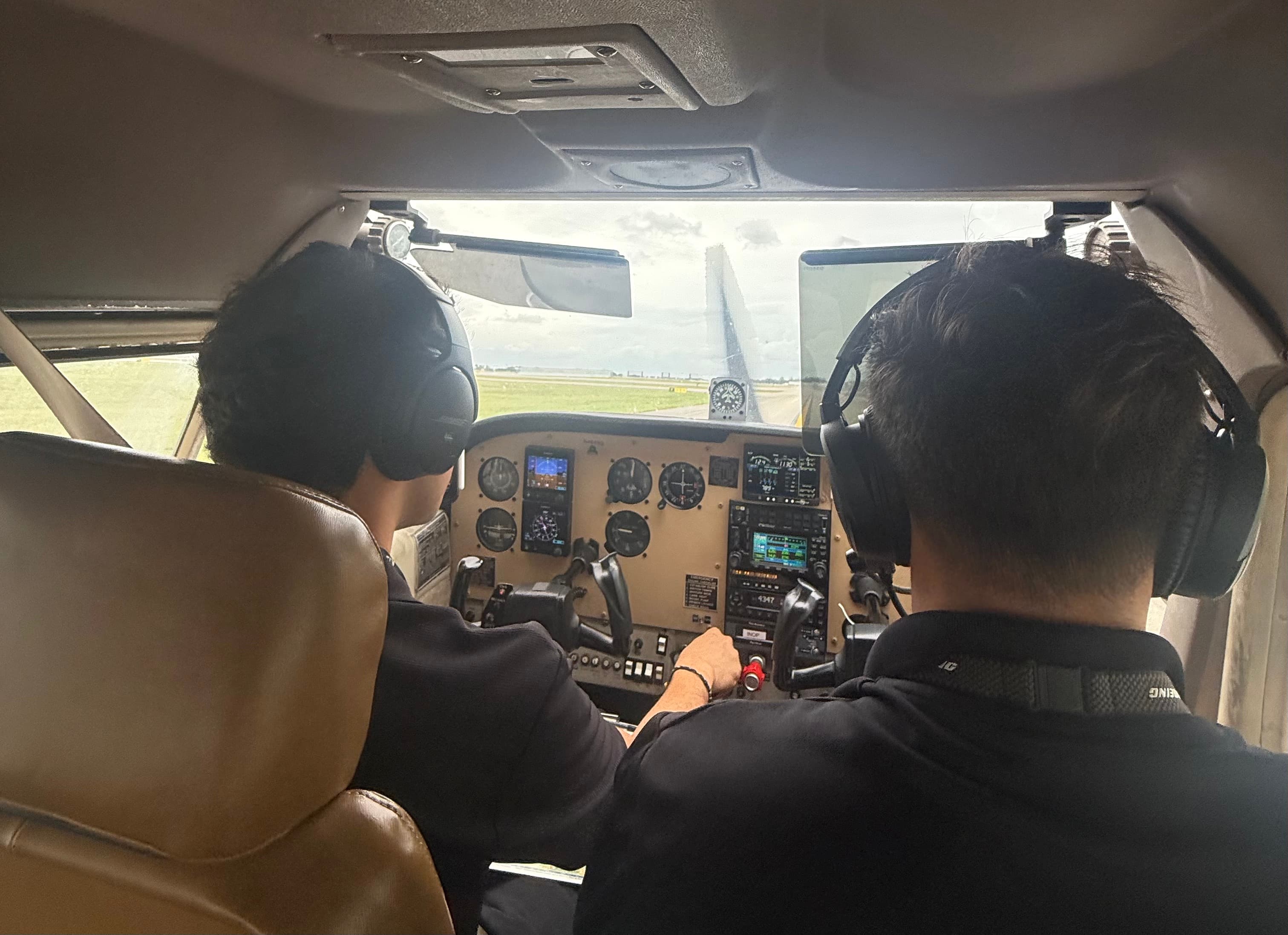
Once you finish your instrument rating, the road to your commercial certificate comes down to one number: total flight time. Unlike the cross country and simulated instrument requirements built into your 141 instrument syllabus, there are different ways to maximize your total time properly as you're time-building. Splitting time-building flights with another pilot is one such useful strategy. If you and a fellow pilot split a two hour cross country flight, you can both log time toward your 250 hour total-time commercial requirement, even during the time you weren't the one at the controls, while only paying for half the rental cost.
How to Log It
The rule that makes this work is simple once you break it down. You can log:
PIC time for the time that you're actively at the controls OR acting as Safety Pilot.
Cross country time only for the leg you're actually flying
Simulated instrument time only for the portion where you're the one under the foggles
So on the leg that you fly, you log PIC, cross country, and simulated instrument time. On the leg your friend flies, you still log PIC time for however long your friend is under the foggles. This is because as the safety pilot you are responsible for traffic separation.
IMPORTANT: During the leg your friend is flying, you cannot log cross-country time, only PIC time that is equal to the simulated instrument time your friend is logging.
Example Scenario
You and a fellow pilot plan a cross country flight and split it into two legs.
You fly the the first leg of 1.0 Hours. Your friend flies the second leg of 0.9 Hours.
For the 1.0 Leg; you can log: PIC: 1.0 , Cross-Country: 1.0 , Simulated Instrument: 0.8
For the 0.9 leg; your friend logs: PIC: 0.9, Cross-Country: 0.9, Simulated Instrument: 0.7
SAFETY PILOT TIME
You can log an additional 0.7 Hours as PIC, the time that your friend was under the foggles.
Your friend can log and additional 0.8 Hours as PIC, the time that you were under the foggles.
Your Logbooks:
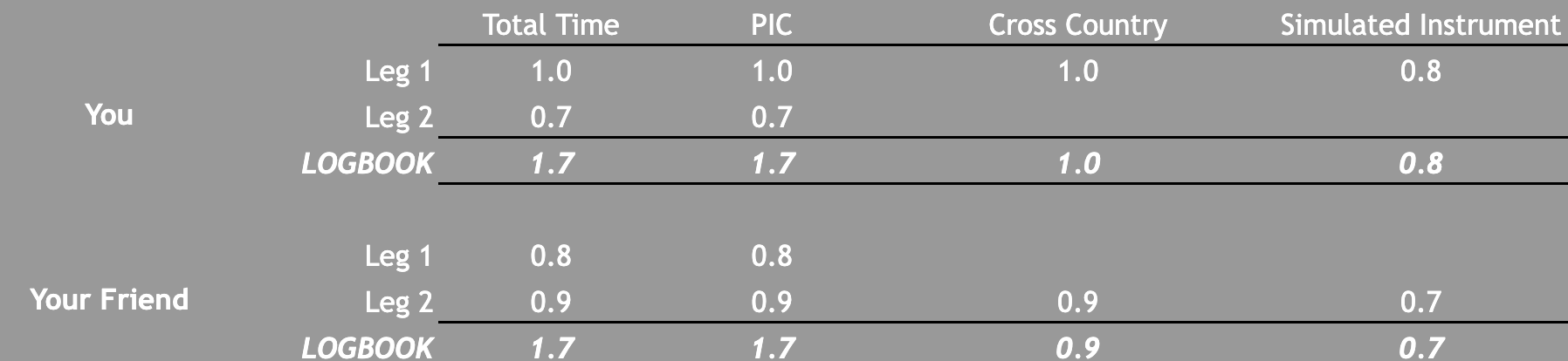
Both you and your friend are logging 1.7 hours of total time, nearly the entire flight, and only paying for half of the cost of the airplane rental. This maximizes your hours logged and reduces the cost significantly as you build your way to the 250 hour total time requirement for your commercial.
Getting the logging right matters, since a logbook that isn't split correctly can create problems later when you apply for your commercial certificate. If you're ever unsure how to log a shared flight, ask one of our instructors before you fly it rather than sorting it out afterward.
If you're finishing your instrument rating and thinking ahead to the time building phase, we're happy to help you plan cross country flights and set up a logging system that keeps everything accurate as you work toward your commercial certificate.