

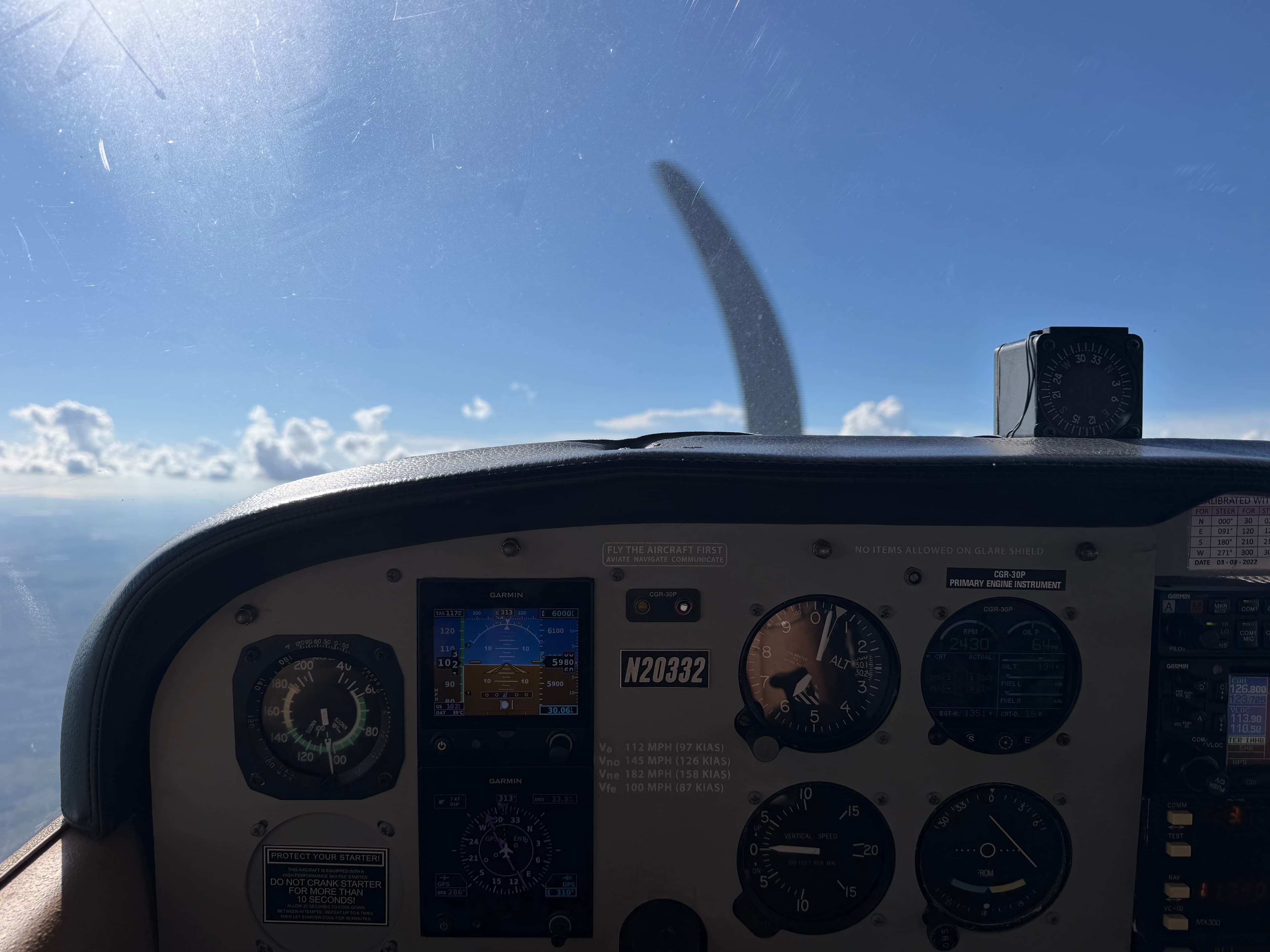
If you have looked at flight schools in Miami, you have probably seen aircraft described as having "glass" or "steam" panels. For a new student, the difference can sound like marketing. It is actually one of the more practical things to understand before you start flying lessons, because the instruments in front of you shape how you learn to scan, how you build situational awareness, and how smoothly you transition to the aircraft you will fly after training.
This article explains what a glass cockpit is, how it differs from traditional steam gauges, and why the combination of Garmin G5 displays and a Garmin 430W is a very good fit for both private pilot and instrument rating training.
What "Steam Gauges" Actually Means
Steam gauges are the traditional round instruments found in most light aircraft built over the past several decades. The standard "six pack" includes the airspeed indicator, attitude indicator, altimeter, turn coordinator, heading indicator, and vertical speed indicator. Each one is its own mechanical or gyroscopic instrument, with its own dial, its own sensor, and its own way of failing.
They are proven and reliable, and every pilot should know how to fly with them. But because each instrument is independent, the pilot has to build the full picture by scanning across the panel and combining the pieces mentally. Airspeed is in one place, altitude in another, heading somewhere else. During instrument training in particular, that cross-check is a large part of the workload, and it can slow down a student who is still learning what each gauge is telling them.
What the Garmin G5 Is
The Garmin G5 is a compact electronic flight instrument that replaces traditional gauges with a digital display. Instead of a spinning gyro, it uses solid-state sensors to determine attitude and heading, which means fewer moving parts and no dependence on a vacuum pump for the instruments it replaces.
In our Cessna 172 fleet, each aircraft flies with dual G5s. One is typically configured as the primary attitude display, showing the horizon along with airspeed, altitude, vertical speed, and slip and skid information on a single screen. The other is configured as an electronic HSI, replacing the traditional heading indicator and showing heading, course, and course deviation in one place. The G5 also has its own internal battery backup, which gives it a useful degree of independence from the aircraft's electrical system.
For a student, the practical result is that the information you need most often is grouped where your eyes already are. You see attitude, speed, and altitude together instead of hunting across the panel for them.
Why Glass Makes the Picture Easier to Read
The main advantage of a glass display is not that it looks modern. It is that it presents related information together.
On a steam gauge panel, each instrument is a separate source, and the pilot's brain does the integration. On a G5, much of that integration is done for you. The airspeed and altitude tapes sit beside the horizon, so a small pitch change shows up immediately in the numbers you care about. Trends are easier to see, and the display makes it harder to fixate on a single instrument while something else drifts.
This matters for a student pilot in a few concrete ways:
A shorter scan. With more information in one area, you spend less time moving your eyes between instruments, which leaves more attention for outside the aircraft during VFR training.
Clearer trend information. Seeing the rate of change in altitude or heading helps students correct earlier and with smaller inputs.
Easier recovery of the picture. If you lose track of your situation, one display shows attitude and the key numbers together, which makes it easier to recover.
Less confusion about heading. A digital HSI shows heading and course together, so understanding where you are relative to a course is much more intuitive than reading a separate heading indicator and course indicator.
None of this means steam gauges are bad. They are a fine way to fly, and the fundamentals do not change. But for someone learning, a display that does some of the integration for you lowers the barrier to understanding what the airplane is doing.
Where the Garmin 430W Fits In
The Garmin 430W is the navigation and communication side of the setup. It is a GPS/NAV/COM unit that is WAAS-capable, which means it can fly the precision-like approaches that use GPS with vertical guidance, commonly called LPV approaches. It also receives traditional VOR and ILS signals, so a student can learn both older and newer forms of navigation on the same unit.
WAAS improves the accuracy and integrity of the GPS position, and that is what makes an approach with a glidepath possible without a ground-based ILS at every airport. For instrument students, that is a major point. A large share of the approaches flown in real-world IFR operations today are GPS approaches, and learning them on a WAAS-capable unit means learning what you will actually use after the checkride.
Why the G5 and 430W Work Well Together
The two units complement each other in a way that suits training.
The G5, configured as an HSI, can display course guidance from the 430W. When the 430W is flying a GPS course or an approach, the G5 shows the course deviation and, on an approach with vertical guidance, the glideslope. The student sees the navigation picture on a clean digital display rather than interpreting a separate CDI.
For private pilot training, this gives a student a modern, understandable way to learn navigation, track a course, and build situational awareness on cross-country flights, including along the South Florida coast. Direct-to navigation and moving map features also make it easier to learn how a GPS fits into good airmanship, without replacing basic pilotage and dead reckoning.
For instrument rating training, the combination lets a student practice a full range of procedures: VOR and ILS approaches, GPS approaches, holds, and intercepts. Because the displays are clear and the information is grouped, students can focus on learning the procedure instead of struggling to decode the instruments.
It is also a realistic setup. Many of the aircraft pilots go on to fly after training have some mix of glass and GPS navigation, so what a student learns here carries over.
Other Avionics in Our Fleet
Not every aircraft in our fleet has the same panel, and that is intentional. Our Cessna 172s share the dual G5 and 430W layout, which keeps training consistent across the aircraft most students fly. Other aircraft in the fleet use different equipment, including the Garmin G300 in our Cessna 162 Skycatcher, the Avidyne Integra in our Cirrus SR20, and Garmin GI275 displays in our Piper Aztec.
Each of those systems presents information a little differently, but the core ideas are the same: integrated flight instruments, GPS navigation, and a scan built around grouped information. A student who learns well on the G5 and 430W will find those other panels familiar when they move on to commercial, multi-engine, or higher-performance aircraft.
What About Learning on Steam Gauges?
A fair question is whether a student who trains with glass instruments is missing something. The answer is that the fundamentals of instrument flying, which are pitch, power, trim, and a disciplined scan, apply on any panel. A good instructor teaches those first and teaches the aircraft's specific instruments second.
It is still worth understanding how the traditional instruments work, including the pitot-static system and gyroscopic principles, because that knowledge underpins the written exam and your understanding of failures. Standby instruments are also part of the picture, and students should know how to use them. Learning on glass does not remove that responsibility. It just means the primary display is easier to read.
Choosing Flight Training in Miami with Avionics in Mind
When you compare flying schools in Miami, panel equipment is worth asking about. The questions that matter are whether the fleet is standardized, whether the avionics are current, whether the navigation unit is WAAS-capable, and whether the equipment supports the training you plan to do, from private pilot through instrument.
A standardized fleet matters more than it might seem. When every aircraft in the main training fleet has the same layout, students spend their time learning to fly instead of relearning a new panel every lesson.
If you are considering flight training in Miami and want to see the avionics for yourself, we would be happy to walk you through the airplanes, answer your questions about our Part 141 programs, or set up a discovery flight so you can see the panel from the left seat.