

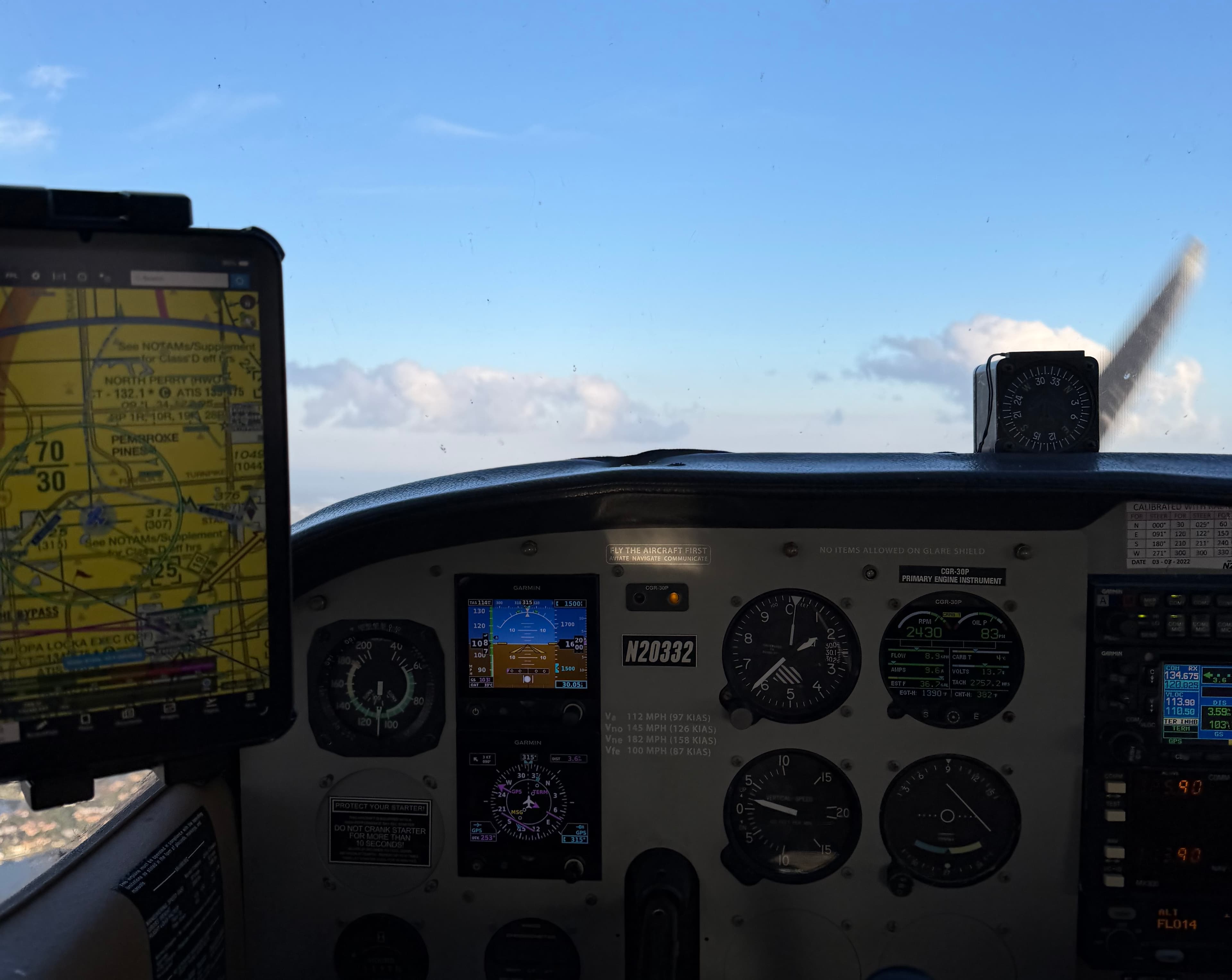
How ADS-B and ForeFlight Work Together for Safer Flying
Aviation technology has changed dramatically over the last decade. Not long ago, many general aviation pilots navigated with paper charts, called Flight Service for weather updates, and relied almost entirely on visual scanning to identify nearby traffic.
Today, even a relatively simple training aircraft can provide pilots with real-time weather information, GPS positioning, and traffic awareness directly on a tablet.
Much of that capability comes from the combination of ADS-B and Electronic Flight Bags (EFBs) such as ForeFlight.
While ADS-B is often discussed because of regulatory requirements, many pilots experience its greatest benefits through ADS-B In devices that connect directly to their tablets and provide information that was once unavailable in most general aviation cockpits.
From Paper Charts to Connected Cockpits
Electronic Flight Bags have become one of the most significant advancements in modern general aviation. Applications such as ForeFlight allow pilots to plan routes, review weather briefings, calculate performance, file flight plans, and navigate using moving maps.
On their own, however, EFBs are only displaying information that was downloaded before departure.
The real advantage appears when an ADS-B In receiver is introduced into the system.
Devices such as the ForeFlight Sentry receive broadcasts from the ADS-B network and wirelessly transmit that information to a pilot's tablet. Instead of simply displaying a chart, the EFB becomes a dynamic source of traffic, weather, and position information throughout the flight.
Traffic Awareness in Busy Airspace
For many pilots, the most noticeable benefit of ADS-B is traffic awareness.
Flying in South Florida, for example, often means operating around flight schools, training areas, helicopter routes, banner tow operations, business jets, and airline traffic. Even on a relatively quiet day, there can be a significant number of aircraft operating within a small area.
ADS-B traffic displays allow pilots to visualize nearby aircraft directly on their moving map. Seeing traffic targets, relative altitude, and movement trends provides an additional layer of situational awareness that simply did not exist for most pilots a generation ago.
Of course, ADS-B should never replace looking outside the cockpit. Pilots still need to actively scan for traffic and maintain visual separation whenever possible. However, knowing where to focus that scan can make traffic acquisition much easier, especially in congested airspace.
Weather Information Without Onboard Radar
Another area where ADS-B has transformed general aviation is weather access.
Most training aircraft and personal airplanes are not equipped with onboard weather radar systems. Historically, pilots relied heavily on preflight weather briefings and occasional updates from Flight Service or air traffic control while airborne.
Today, ADS-B weather products allow pilots to view radar imagery, METARs, TAFs, AIRMETs, SIGMETs, and other weather information directly within their EFB.
This does not mean pilots can use ADS-B weather to navigate through thunderstorms. The information is delayed and should always be used strategically rather than tactically. However, it provides a tremendous amount of information for route planning, weather avoidance, and overall situational awareness during flight.
For pilots flying in places like Florida, where weather can change rapidly throughout the day, having access to updated weather information can significantly improve decision making.
GPS and Position Accuracy
Many ADS-B receivers provide another benefit that pilots sometimes overlook: GPS.
Devices such as the ForeFlight Sentry include high-accuracy WAAS-enabled GPS receivers that feed position information directly to the tablet. This allows pilots to use moving maps and navigation features even in aircraft that do not have advanced GPS equipment installed.
For many older aircraft, this capability effectively gives pilots access to modern navigation tools without requiring expensive avionics upgrades.
The result is a cockpit that feels significantly more capable while maintaining the simplicity and affordability that make general aviation accessible.
A Tool, Not a Substitute
Like every advancement in aviation, ADS-B and EFB technology are most effective when used to support good decision making rather than replace it.
Traffic displays do not eliminate the need to look outside. Weather products do not replace proper weather briefings. GPS navigation does not remove the responsibility to understand where you are and where you are going.
What these tools do provide is a level of situational awareness that previous generations of pilots could only dream about.
Final Thoughts
For many general aviation pilots, ADS-B is less about regulatory compliance and more about the information it delivers in the cockpit.
When paired with an EFB such as ForeFlight, ADS-B provides traffic awareness, weather information, GPS positioning, and a clearer picture of the operating environment. Together, these technologies have transformed how pilots plan flights, navigate, and manage risk.
While they will never replace strong stick-and-rudder skills or sound aeronautical decision making, they have become some of the most valuable tools available to modern pilots and have made general aviation safer, more informed, and more connected than ever before.